











What is Fabric Construction?
Fabric construction refers to the way yarns are interlaced to create a fabric. Fabric construction directly affects strength, durability, flexibility, and appearance of a fabric. In a broad sense, construction is divided into woven or knit fabric. Woven fabrics are structured with interlacing warp and weft yarns, while knitted fabrics are made from interlocking loops, making them more stretchable. You can identify fabric construction by using tools like a pick glass, or through visual inspection, stretch tests, and more. Understanding fabric construction is crucial to choosing the best fabric for the application needed.
How is Woven Fabric Constructed?
Weaving is one of the oldest and most common methods of fabric construction. It involves interlacing two sets of yarns at right angles to each other: the warp yarns (vertical) and weft yarns (horizontal).
Three classic weaving patterns are:
- Plain weave (simple over/under pattern)
- Twill weave (diagonal pattern)
- Satin weave (yarn floating over several others before interlacing under one, creating a smoother surface).
How is Knit Fabric Constructed?
The two main types of knitting are:
- Weft (Circular) knitting (loops are formed horizontally, common in sweaters and t-shirts)
- Warp knitting (Loops are formed vertically, used in lingerie and swimwear).
There are many other types of knits as well, including jersey, rib, and interlock.
How to Identify Fabric Construction Using a Pick Glass
A pick glass is a small magnifying tool used to closely examine fabric and measure its thread density. It helps check how tightly woven a fabric is, which is important for quality, durability, and fabric performance. A pick glass may take more time than other methods but provides a more accurate measurement of construction. The steps to using a pick glass are:
- Place the pick glass on the fabric.
- Count the warp (vertical) and weft (horizontal) threads in a set area (usually 1 square inch).
- This number helps determine the fabric’s density and construction.
How to Identify Fabric Construction Using a Densimeter
The moire pattern on the densimeter helps make the fabric’s threads easier to see and count. When placed over the fabric, the pattern changes as you adjust the tool. Lighter-colored fabrics (such as white or pastel shades) generally produce clearer moire patterns because the contrast between the fabric and the gauge’s lines is more visible. The steps to using a densimeter are:
- Place the densimeter on the fabric.
- The point of the pattern will align with a number on either the Lines per Inch (LPI) or Lines per Centimeter (LPC) scale.
- This number shows the fabric’s thread density, making it a quick and accurate way to measure warp and weft threads.
What are Other Ways to Determine Fabric Construction?
Visual Inspection – Check the pattern. Woven fabrics have a crisscross structure (warp & weft). Knitted fabrics have interlocking loops forming a V-shape. Non-woven fabrics have random fiber arrangements with no clear structure.
Stretch Test – Gently pull the fabric. Woven fabrics stretch only slightly, mainly on the bias. Knitted fabrics stretch significantly, especially widthwise.
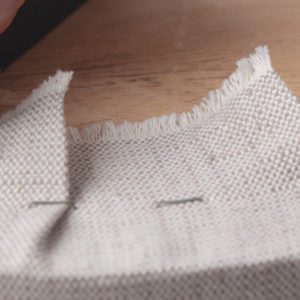
Fraying Test – Examine the cut edge of the fabric. Woven fabrics fray along the edges. Knitted fabrics do not fray but may unravel if a loop is pulled.
How is Fabric Density Measured?
Fabric density is the number of yarns or stitches per inch. In woven fabrics, this is measured in ends per inch (EPI) in the warp direction and picks per inch (PPI) in the weft direction. In knit fabrics, density is determined by stitches per inch (SPI) and loop size.
The density of a fabric affects the strength, weight, drape, breathability, durability, and comfort of a textile.
Higher density construction means that the fabric will:
- be stronger, more durable, and with better resistance to wear and distortion
- be stiffer, holds shape better
- traps heat, offering better insulation
Lower density construction means that the fabric will:
- be weaker, more prone to fraying (woven) or stretching out (knit)
- have a softer, fluid drape
- have better airflow, ideal for hot weather