


















What transforms transactions into true partnership? For Kornit Digital and TVF, it’s not exclusively about the best fabric printing products on both ends of the equation — it’s about consistency.
Kornit Digital, an ink and printer manufacturer that is a world leader in the print-on-demand space, specializes in roll to roll and direct to garment digital printing services. Their knowledge within their domain is unparalleled, and when Kornit loads fabric into printers for demonstrations, two major considerations inform the substrate selection:
“One thing we really treasure about the TVF products is the quality and consistency with anything,” says Kornit Digital Presales Applications Manager Matthew Meany during an upcoming episode of The Textile Nerd Podcast. “If you’ve got variables, it’s going to be a variable in your final product. So, with the TVF products, we’re getting both: not only the quality, but consistency.”
A lot is at stake with printer demonstrations, so it’s crucial to find a fabric that works correctly every time. The manufacturer, the fabric supplier, and the customer have all invested time and money heavily before the process even reaches showtime.
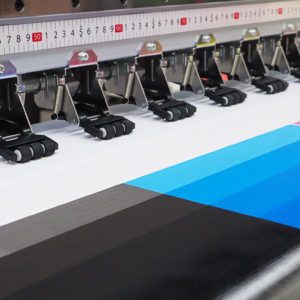
“When you’re in a demo, you’ve got someone that got in a plane, flew all the way to see you, took their time, and they want to see that machine. The last thing you want to see are print issues.” Meany says, adding that Kornit’s Presto series printers take rolls that are in widths of up to 70 inches. “You’re webbing it up. You’ve got to feed that into a machine where you’ve got upwards of 60 print heads that are riding about two and a half to five millimeters above that fabric.”
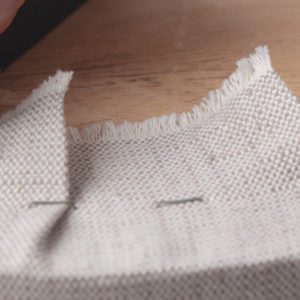
The knowledge transfer among printing partners is also a key piece of the equation. By the time a printer is ready to be showcased, hours of research, development, trials, errors, and deep conversations have already been poured in between parties. Each player should have opportunities to troubleshoot, offer informed suggestions, and make adjustments. One example of where deep knowledge of the fabric matters is the selvedge, which Meany calls one of the biggest challenges for printing roll-to-roll.
“Are they frayed? Are strands of fabric sticking up? Are they curled?” Meany asks. “So, if you’ve got your knit fabrics like your jerseys… your knit cottons… if you ever ripped a t-shirt, you see the fabric immediately curls up. You can’t really have that on a digital printer like ours.” To capture fine detail, Meany says the print heads can only ride 2 ½ to five millimeters above the fabric. (Meany says Kornit often demos their printers using Nevada Jersey, Organic Cotton Interlock, and others from TVF.)
Meany says Kornit Digital works with suppliers to thoroughly test and trial textile substrates so professionals that use their printers can rely on the pre-settings and codecs for consistent results.
“Part of those programs are to bring fabrics in, test them, dial them in as we call it, come up with a default set of settings for the roll to roll things like TVF fabrics. We’ll build a color profile and dial in those settings. it’s really the kind of nice thing about it is, yeah, there’s a lot of knobs and buttons that you can adjust, but we really try and avoid that during that process.” Ideally, Meany says his desired outcome for those who use Kornit equipment is: “Here’s the color profile. You’ve got a machine. As long as it’s calibrated right, you’re good to go.”
To sum up the importance of collaboration, consistency, and quality, Meany says: “So, once again, if you’ve got fabric that’s got issues where things are sticking up, it’s a problem. And that’s really one of the things that we rely on TVF for. I can honestly say, I could take the roll, put it on the machine… I can print that whole roll without issues. It’s one of the things that stands the TVF product apart.”